
Romance
A recurring idea that shapes Anna Karenina.
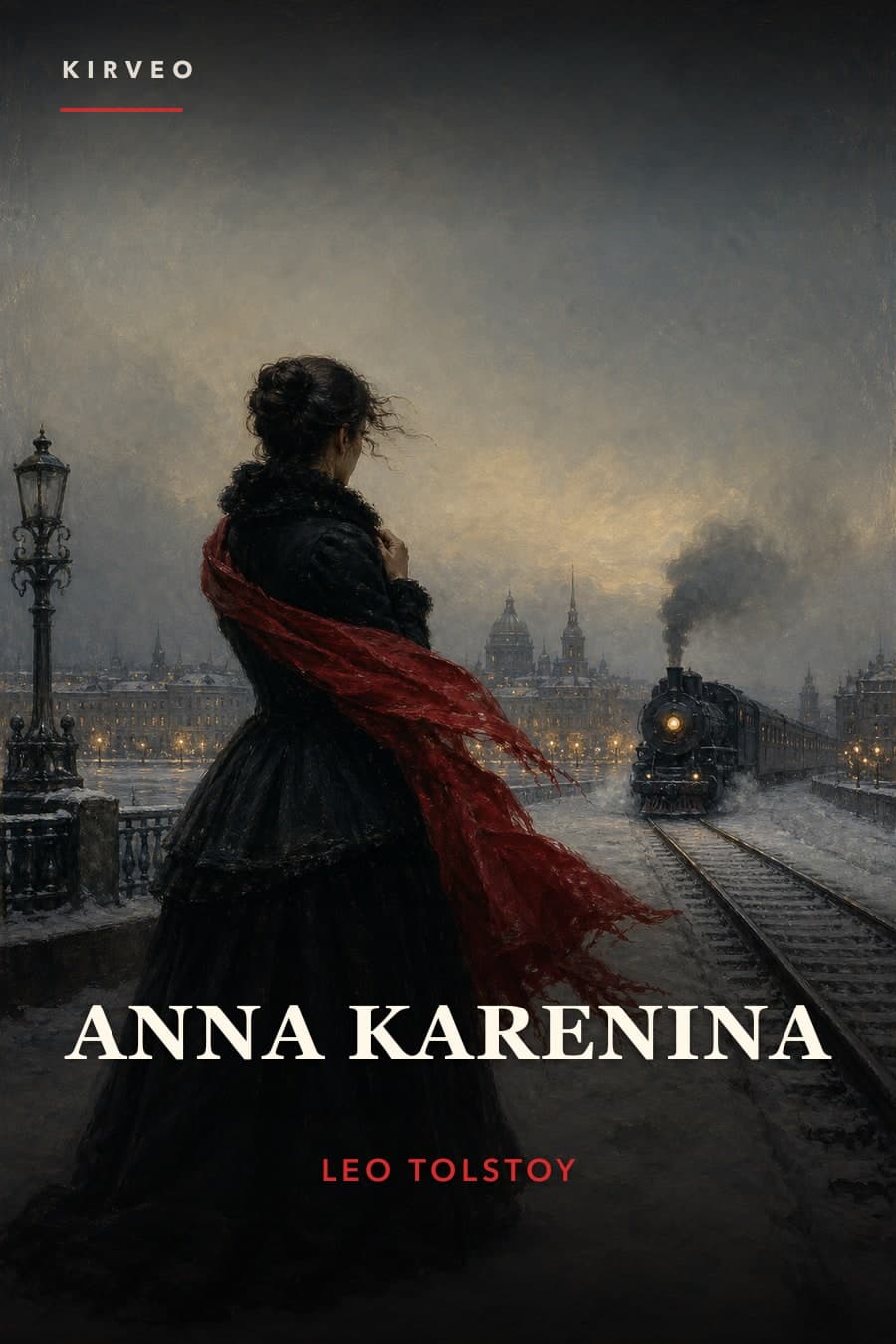
Interwoven households expose the pressures of love, marriage, family, faith, and social judgment in imperial Russia.
The supplied excerpts from Anna Karenina (Leo Tolstoy, 1878) do not permit a full plot account; they are a representative sample of 8 of 239 chapters. In Ch.1, the Oblonsky household is in disorder after the wife learns of her husband Stepan's affair with a governess; his involuntary smile at confrontation deepens the rupture. Ch.17 shows Stepan meeting Vronsky at a station; Vronsky's mood suggests romantic involvement (later linked to Kitty Shtcherbatskaya). Ch.41 depicts Anna Karenina at a gathering where she tells Vronsky their connection must end and urges him to seek Kitty's forgiveness, yet they acknowledge mutual attraction. Ch.80 follows Levin managing hay meadows on his sister's estate, observing peasants and a young couple's evident love. Ch.120 shows Alexey Alexandrovitch at his ill wife Anna's bedside, experiencing unexpected pity and forgiveness. Ch.160 portrays Levin and pregnant Kitty walking and discussing others' capacity for love. Ch.199 has Levin visiting Anna, who expresses isolation and asks him to convey she is unchanged in feeling to his wife. Ch.239 closes with Levin alone on a terrace, reflecting that faith emerged through suffering and gives life meaning despite his continued flaws. These passages indicate interlocking family and social plots but omit resolutions and most events.
The author of Anna Karenina.
Explore author profileThis work develops its ideas directly rather than through a character-led narrative.
Anna Karenina belongs to the literary and cultural world of Public-domain literature.
The supplied excerpts from Anna Karenina (Leo Tolstoy, 1878) do not permit a full plot account; they are a representative sample of 8 of 239 chapters. In Ch.1, the Oblonsky household is in disorder after the wife learns of her husband Stepan's affair with a governess; his involuntary smile at confrontation deepens the rupture. Ch.17 shows Stepan meeting Vronsky at a station; Vronsky's mood suggests romantic involvement (later linked to Kitty Shtcherbatskaya). Ch.41 depicts Anna Karenina at a gathering where she tells Vronsky their connection must end and urges him to seek Kitty's forgiveness, yet they acknowledge mutual attraction. Ch.80 follows Levin managing hay meadows on his sister's estate, observing peasants and a young couple's evident love. Ch.120 shows Alexey Alexandrovitch at his ill wife Anna's bedside, experiencing unexpected pity and forgiveness. Ch.160 portrays Levin and pregnant Kitty walking and discussing others' capacity for love. Ch.199 has Levin visiting Anna, who expresses isolation and asks him to convey she is unchanged in feeling to his wife. Ch.239 closes with Levin alone on a terrace, reflecting that faith emerged through suffering and gives life meaning despite his continued flaws. These passages indicate interlocking family and social plots but omit resolutions and most events.
Begin by following how romance and realist fiction shape the work’s central choices.
Anna Karenina was written by Leo Tolstoy, as indicated in the page metadata. The work has confirmed public domain status, meaning it is freely available.
The metadata lists the original language as English, which conflicts with the original Russian title and author's nationality. This appears to be a metadata error, as the work was originally written in Russian.
The reading difficulty is listed as intermediate. The language is 19th-century translated English with period phrasing, and the structure follows many characters across 239 chapters, requiring attention to tracking plot lines.
Source and editorial notice
Public-domain source information is preserved with the published edition. This reading guide was created with AI assistance and reviewed before publication.