
Creation and responsibility
Knowledge creates obligations that achievement alone cannot satisfy.
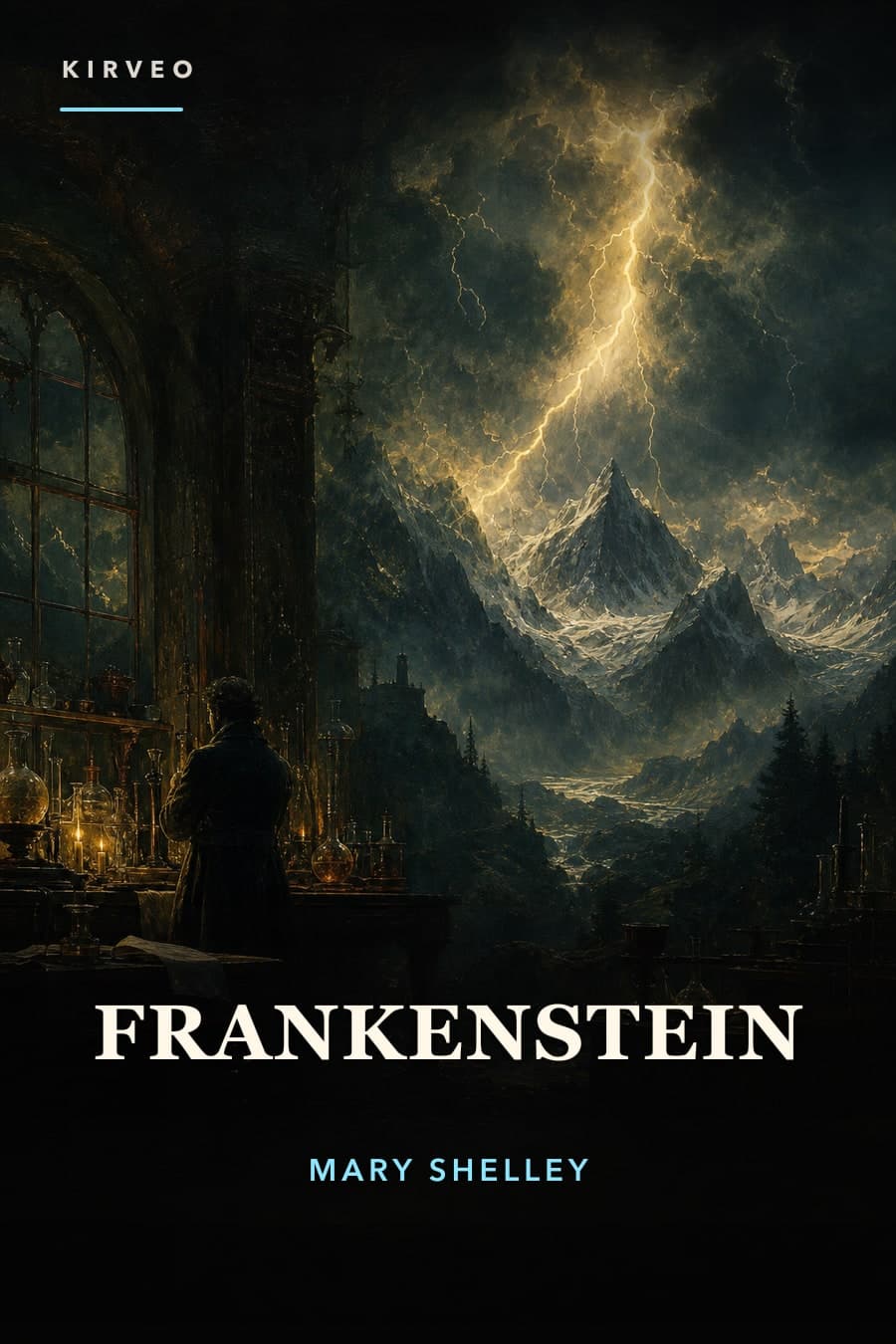
Victor Frankenstein’s experiment forces creator and creation to confront abandonment, responsibility, knowledge, and the need for companionship.
The supplied excerpts present a partial arc of Mary Shelley's 1818 novel without revealing later plot turns. The book opens with Robert Walton's letters to his sister from St. Petersburg and the Arctic, describing his voyage toward the pole and his confident, solitary ambition (Letter 1, Letter 3). The narrative then shifts to Victor Frankenstein's recollections: raised with Elizabeth in Switzerland, he develops intense thirst for knowledge and reads Agrippa after his father dismisses it as 'sad trash' without explanation, an act Victor later ties to his ruin (Ch.2). Victor studies, falls ill, and receives anxious letters from Elizabeth relayed by friend Clerval (Ch.6). Later chapters give the creature's perspective: he recalls confused awakening of senses, learning to observe a cottager family, acquiring language and books, and being violently driven away when he seeks their protection (Ch.11, Ch.15). In a later lab scene, Victor considers creating a second being and fears its unknown malice (Ch.20). The ending samples show Victor pursued by the creature, declaring revenge his only life motive, and the creature's final speech before leaving the ship on an ice raft (Ch.24). The text does not, in these samples, disclose central deaths or final resolutions beyond the creature's departure into darkness.
Mary Shelley was a novelist, editor, and biographer whose Frankenstein reshaped the literature of creation and responsibility.
Explore author profileThis work develops its ideas directly rather than through a character-led narrative.
The novel responds to scientific experimentation, revolution, education theory, and debates over human perfectibility.
A foundational work of science fiction and a lasting ethical parable about making life, told through competing narrators.
Keep the frame narratives visible. Each speaker asks to be understood, and the ethical problem changes depending on whose account receives belief.
The novel uses an epistolary framing device. It opens with letters from explorer Robert Walton to his sister, which then enclose Victor Frankenstein’s tale. Within Victor’s story, the Creature gives his own account. This nested structure gives multiple perspectives on the central events.
The subtitle links Victor Frankenstein to the Greek myth of Prometheus, who stole fire from the gods and was punished. Similarly, Victor creates life in defiance of natural boundaries, and the story explores the consequences of overreaching ambition.
The reading guide suggests reading the opening letters as a frame, tracking which voice is narrating, noting dates and locations, and pausing when the Creature speaks to compare his account with Victor's. It also advises using the discussion questions for reflection rather than fixed answers.
Source and editorial notice
Public-domain source information is preserved with the published edition. This reading guide was created with AI assistance and reviewed before publication.